Thinking about adding an ADU in Atwater? You are not alone. Across California, accessory dwelling units have become a practical way to create extra living space, add rental income, or make a property work better for your long-term plans. If you own a home in Atwater or are considering an investment property here, understanding how ADUs work can help you spot opportunity and avoid costly missteps. Let’s dive in.
Why ADUs Matter in Atwater
An ADU, or accessory dwelling unit, is a secondary residential unit on the same lot as a primary home. It can be attached or detached, and it must include independent living facilities. A JADU, or junior accessory dwelling unit, is smaller and must be contained entirely within a single-family home, with a maximum size of 500 square feet under California guidance.
For Atwater homeowners and small investors, ADUs can solve more than one problem at once. They can create space for extended family, offer a source of rental income, and support aging in place. In a market where buying additional land is expensive, adding usable housing on an existing lot can be a smart move.
California has also made ADUs a major part of housing production. According to the California Department of Housing and Community Development, ADU permits increased from 1,336 in 2016 to 30,354 in 2024. In 2024, ADUs accounted for more than 26.6% of all homes permitted statewide.
How California ADU Rules Help
California law has made ADUs much more workable than they used to be. That matters in Atwater because the city is a general law city, which means local ADU rules must fit within California Government Code limits.
One of the biggest advantages is the approval process. ADU and JADU applications are reviewed ministerially, not through a discretionary process. That means the city must approve or deny a completed application within 60 days.
The state also limits how restrictive local standards can be. In many cases, side and rear setbacks for an ADU cannot exceed 4 feet. Parking rules are also capped, with requirements generally limited to one space per ADU or bedroom, whichever is less.
Some projects get even more relief. If you convert existing living space or an accessory structure, there may be no setback requirement in some situations. If a garage, carport, or parking area is demolished for an ADU, those spaces do not have to be replaced under state rules.
What Atwater Adds Locally
Atwater has its own ADU ordinance in Chapter 17.28, but it is designed to comply with California law. The city states that conforming ADUs and JADUs are not treated as inconsistent with the general plan or zoning, do not count against allowable density, and are not required to fix nonconforming zoning conditions.
That is good news if you are evaluating whether a property has ADU potential. It means the city recognizes ADUs as a valid housing option rather than treating them like a zoning exception.
Atwater also uses objective local standards that affect early planning. These may include side and rear setbacks, front-yard setbacks, parking rules, design controls, and the fact that no passageway is required. Since parcel conditions vary, you should confirm the exact standards for your property with the city before paying for final plans.
Atwater’s Preapproved ADU Plans
One of the most practical local advantages is Atwater’s preapproved detached ADU plan program. In 2024, the city approved several pre-reviewed detached layouts to help streamline the process.
The approved designs include:
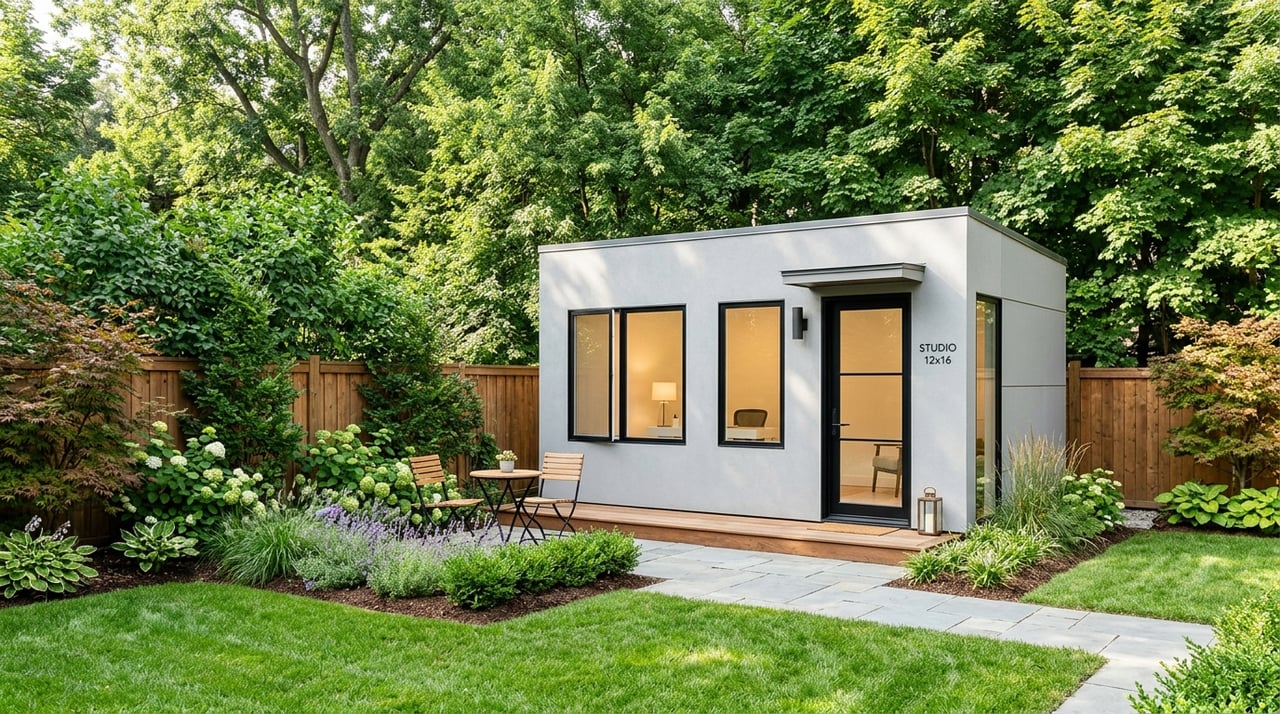
- 375-square-foot studio
- 550-square-foot one-bedroom
- 743-square-foot two-bedroom
- 908-square-foot two-bedroom
If you use a preapproved plan and submit a complete application, the city’s council materials say the application must be approved or denied within 30 days. That can be a meaningful time-saver if you want a detached unit and your lot fits one of the available designs.
Common ADU Options in Atwater
Not every ADU project looks the same. The best fit usually depends on your lot, budget, existing improvements, and long-term goal.
Garage or Existing Space Conversion
This option can work well if you already have underused space. State rules are especially favorable to conversions because ADUs and JADUs created from existing space generally cannot be required to install a new or separate utility connection, unless they are built at the same time as a new single-family home.
Conversions can also benefit from flexible setback treatment in certain cases. If you want to keep costs more controlled, this may be one of the first paths worth exploring.
Attached ADU
An attached ADU shares a wall with the primary home but functions as a separate residence. This option can make sense when the lot has limited backyard space but the existing house layout allows for an addition.
Attached units may appeal to homeowners who want family nearby while still maintaining a degree of privacy. They can also be easier to integrate visually with the main home.
Detached ADU
A detached ADU creates the most separation from the primary residence. For homeowners focused on privacy, long-term rental use, or a flexible guest space, a detached structure often offers the clearest independent feel.
This is also where Atwater’s preapproved plans may be especially useful. If your parcel supports one of those layouts, you may be able to simplify the design and permitting path.
JADU
A JADU is a smaller option that must be located entirely within a single-family home. Because it is capped at 500 square feet, it may be a fit for owners who want a compact unit without building a full detached structure.
This option can be useful when you want to maximize existing square footage rather than expand outward. Still, the exact owner-occupancy and sanitation details can differ from standard ADU rules, so it is important to confirm the project setup with the city.
Fees, Parking, and Utilities to Know
A few rules can make a big difference to your budget. Under California guidance, ADUs of 750 square feet or less are exempt from impact fees. JADUs of 500 square feet or less are also exempt, and school fees are generally not charged for ADUs or JADUs under 500 square feet.
Parking is another area where owners often expect more hurdles than they actually face. Atwater follows the one-space rule and allows tandem or setback parking, with exemptions tied to transit proximity and certain conversion situations.
Utilities can also affect feasibility. For conversions of existing space, separate utility connections are generally not required unless the ADU is built concurrently with a new single-family home. That can reduce both cost and complexity for the right project.
Rental and Ownership Considerations
Many owners look at ADUs for income potential, and that is a valid reason to explore one. California guidance notes that ADUs can provide rental income, and Atwater’s local code states that ADUs and JADUs may not be rented for fewer than 30 days.
That means these units are better suited to longer-term housing use than short-term turnover. If your goal is steady monthly income or a flexible unit for family now and tenants later, that can still make an ADU very attractive.
Owner-occupancy rules are also more flexible than many people assume. In general, local agencies cannot require owner occupancy for ADUs, except in limited separate-conveyance situations. JADUs can have different occupancy rules in certain cases, so that is another item to verify before you commit to a design.
What ADUs Can Mean for Resale
A permitted ADU can make your property more versatile. Buyers may see value in having room for extended family, a separate living area, or rental income potential.
That said, resale impact is never automatic. The actual value depends on legal status, lot fit, parking, privacy, design quality, and how well the ADU functions with the main residence.
For sellers in Atwater, this is where strategy matters. A well-planned ADU may broaden your buyer pool, but an unpermitted or poorly integrated unit can create questions during a sale. If you are thinking about building with future resale in mind, it helps to evaluate both usability and market appeal early.
Smart Due Diligence Before You Build
Before you spend money on plans, take a step back and confirm the basics. A little upfront research can save time and frustration later.
Start with questions like these:
- Is the lot zoned for residential use?
- Will the project be a conversion, attached ADU, detached ADU, or JADU?
- Is there enough utility capacity for the planned unit?
- Does the parcel have HOA restrictions?
- Do the lot layout, setbacks, and parking conditions support the design you want?
California guidance also notes that HOAs cannot influence ministerial approval by the city, although private restrictions may still create separate issues for the owner to resolve. That is why city approval and private property restrictions should be reviewed as two different things.
How the Atwater Permit Process Works
A simple way to think about the ADU process is in three phases: feasibility, permit review, and construction.
1. Feasibility and Design
This is where you confirm what the lot can support. You will want to review your parcel, choose the project type, and decide whether a custom design or one of Atwater’s preapproved detached plans makes more sense.
2. Permit Review
Atwater’s Building Division uses Cloudpermit for online permitting. Under state law, a completed ADU or JADU application must be approved or denied within 60 days, and Atwater’s preapproved-plan program is intended to move even faster, with a 30-day approval or denial timeline for complete applications using those plans.
3. Construction and Inspections
Construction timing varies by project type. A garage conversion, interior conversion, attached addition, and detached new build all have different construction demands, so there is no one-size-fits-all timeline.
For inspections, Atwater says they must be requested 24 hours in advance before 4:00 p.m. for a next-day inspection. The Building Division also lists permit counter hours from Monday through Friday, 8:00 a.m. to 4:00 p.m.
Why Local Guidance Still Matters
Even with strong statewide ADU rules, every property is different. Lot layout, utility setup, existing structures, and local objective standards all affect what is realistic.
If you are buying a property because you hope to add an ADU later, that due diligence matters before you close. If you already own in Atwater, checking feasibility before hiring designers or contractors can help you avoid spending money in the wrong order.
Whether you are planning for family, future income, or resale flexibility, ADUs can create real opportunity in Atwater when the project is legal, practical, and matched to the property. If you want help evaluating how ADU potential could affect a purchase, sale, or long-term property strategy in Merced County, connect with Martin Villanueva.
FAQs
What is an ADU in Atwater, California?
- An ADU in Atwater is an attached or detached secondary residential unit on the same parcel as a primary home, with complete independent living facilities.
What is a JADU for Atwater homeowners?
- A JADU is a junior accessory dwelling unit located entirely within a single-family home, and California guidance says it can be no larger than 500 square feet.
How long does ADU permit review take in Atwater?
- A completed ADU or JADU application must be approved or denied within 60 days under state law, and complete applications using Atwater’s preapproved detached plans are intended to be approved or denied within 30 days.
What preapproved ADU plans does Atwater offer?
- Atwater’s preapproved detached ADU plans include a 375-square-foot studio, 550-square-foot one-bedroom, 743-square-foot two-bedroom, and 908-square-foot two-bedroom layout.
Do ADUs in Atwater require extra parking?
- Parking requirements generally cannot exceed one space per ADU or bedroom, whichever is less, and some ADUs may qualify for parking exemptions.
Can you rent out an ADU in Atwater, California?
- Yes, ADUs can support rental income, but Atwater’s code says ADUs and JADUs may not be rented for fewer than 30 days.
Are small ADUs exempt from some fees in California?
- Yes, ADUs that are 750 square feet or smaller are exempt from impact fees, and JADUs of 500 square feet or less are also exempt under California guidance.
Who should Atwater owners contact first about ADU rules?
- The best local starting point is the Atwater Building Division, which can confirm current submittal requirements, parcel-specific standards, and permit routing before you pay for plans.